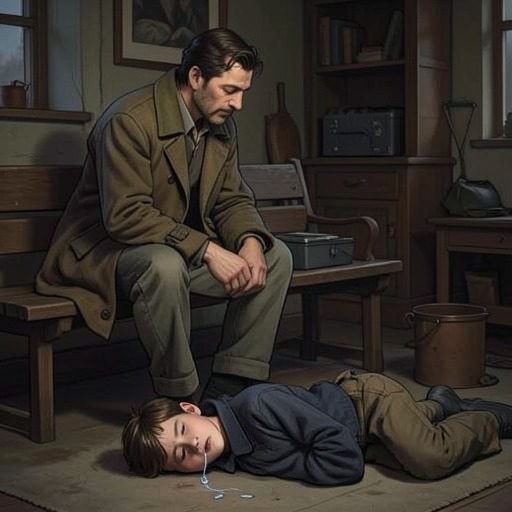
Ish Williams and Joey
Earth AbidesIsh Williams and Joey share a father-son bond shaped by a discovery that gives Ish a new way to imagine the Tribe’s future. Joey is his youngest son, a quiet nine-year-old whose quick, joyful reading makes Ish see in him the possibility of a mind able to carry knowledge forward. Ish responds with eager lessons and deepening affection, but he also recognizes that his hope may be inseparable from a father’s partiality.
Family and the First Recognition
Joey is one of the twins, the youngest of the children born to Ish and Em. Small for his age and less successful at play than some younger children, he has not attracted much notice in the large group. His parents favor him somewhat because he is the youngest, but the relationship changes in force when his reading ability becomes clear. At nine, Joey reads not merely slowly and haltingly, as the other children do, but quickly, accurately, and with pleasure. Ish feels his heart warm toward him and sees the intellectual light still burning in his son.
The discovery gives the community a name for the year: the Year When Joey Read. It is one of the small incidents by which the Tribe marks its years, but for Ish the incident is more than a family milestone. The children’s recognition of Joey’s reading makes public what Ish experiences privately as a sign of possibility. The name fixes the moment in communal memory, while Ish’s response reaches beyond the achievement itself to what Joey might become.
Attention, Affection, and Teaching
At a gathering where adults speak in a circle, several children linger nearby, restless or only half-interested. Ish thinks that the older people may manage with existing arrangements for the rest of their lives, while the children will need to adapt; their generation might supply the spark for change. Among the children, Joey is not scuffling. He sits listening steadily, his bright, interested gaze following the adults’ discussion. When he notices his father watching him, he grins; Ish winks back, and Joey answers with a flutter of his eyelid. Ish then looks away so that the attention will not embarrass him.
That small exchange makes the bond visible without turning it into a lesson or a speech. Joey’s interest in the adults’ talk offers Ish a reason to connect his son’s intelligence with the community’s needs, while the grin and answering wink reveal their private warmth. Ish’s hope is therefore fed both by what Joey can do and by the ease of their recognition of one another.
After Ish identifies Joey in his mind as the possible Child of the Blessing, he presses the lessons, and Joey absorbs them eagerly. The teaching gives Ish a concrete way to act on his hope: rather than leave Joey’s ability as a promise, he tries to cultivate it. Yet the evidence does not make Joey a leader among the children. Ish sees little sign of that capacity, and sometimes worries that intensive instruction may produce a learned pedant instead of the person the Tribe needs. Their relationship thus carries a practical tension: Ish is educating a son he loves, but he is also testing a large expectation against the child’s actual character.
Sympathy and Ish’s Doubt
Joey’s attentiveness is not limited to lessons. On one occasion, he balances nearby, lets his gaze wander around the room, and returns it to his father. Ish gently sends him off and says that their lesson will take place at the regular time. Joey leaves, but Ish is moved, and slightly humiliated, by the wordless sympathy he has offered. Joey cannot fully understand the larger issues, Ish thinks, yet his quick mind has sensed that his father is unhappy even though no argument has occurred between Ish and the others.
The moment deepens Ish’s sense of Joey as perceptive, but it also complicates that interpretation. Ish wonders whether the boy’s withdrawal from children who are better at games is thought for the future, or whether Joey is seeking security with a father who appreciates him. He hopes the other children have not noticed how strongly he favors Joey. Ish knows that favoritism is not right, and describes its arrival as sudden and involuntary. His affection is sincere, but his own account shows how readily it can shape what he takes as evidence of exceptional promise.
The Child of the Blessing and an Unsettled Future
Ish’s conviction begins on New Year’s Day, when the name Joey comes to him as the answer to a larger question. The idea draws on the image of a rare child who sees not only what exists but what does not yet exist, and can imagine what may be. In Ish’s understanding, such a child must arrive at a fitting time and place and must live long enough to meet the world’s need. Joey’s quickness in lessons and attentive listening seem to fit the hope, but neither guarantees its fulfillment.
Ish’s own thoughts preserve that uncertainty. He wonders whether his certainty is only the feeling a father has for a small son, recalls that he and Joey may later quarrel as he does with Walt, and admits that he does not know. Still, he hopes and resolves to keep trying. The relationship consequently joins affection to an unresolved responsibility: Ish wants Joey to inherit more than the Tribe’s present arrangements, but can only teach him and watch for signs, not know what the child will become.
Joey’s reading gives Ish a moment of renewed belief after years in which he had warned that something would happen and had been treated as a gloomy prophet. Ish thinks that when disaster finally arrived, he had failed to make others act; his regret sharpens the importance he assigns to a child who might see ahead. Joey is not shown confirming that hope through later achievements in these passages. Instead, the father-son bond rests on a discovery, a course of lessons, small gestures of mutual attention, and Ish’s alternating certainty and self-questioning. Its significance lies as much in that fragile uncertainty as in the promise Ish sees in his son.